Please contact me at Christine_Slobogin@URMC.Rochester.edu if you would like a PDF of any of these pieces.
“The Dental Phantom as a tool for Exploring Fear, the Face, and Dental Education,” Journal of the American College of Dentists 92, no. 2a (Winter 2026): 50-56.
The full issue is available open access here. This two-part special issue on “The Intersection of Humanities and Ethics in Dentistry” is co-edited by my colleagues in the National Collaborative on Humanities and Ethics in Dentistry, of which I am Chair.
“Punchlines and Power: Visual Humour as a Disruptive Tool for the Critical Medical Humanities,” in Art and the Critical Medical Humanities (Bloomsbury, February 2026).
Co-authored with Katie Snow and Laura Cowley (my co-editors for the forthcoming volume Sick Jokes), this chapter considers humor in the context of medicine and health, looking at a range of visual sources including eighteenth-century caricature, cartoons of mid-twentieth-century operating theatres, and works by twenty-first-century self-identified disabled artists.
Art and the Critical Medical Humanities is an agenda-setting edited volume that makes a forceful case for the contribution that art – its practices and its histories – can make to debates and developments in critical medical humanities today. It is available open access online here.
Putting Plastic Surgery on Paper: How Art and Archives Defined Second World War Reconstructive Surgery in Britain (University of Rochester Press and Boydell & Brewer, June 2025).
Available to purchase on the publisher’s site here. Use code BB135 for 35% off.
Available to read open access here.
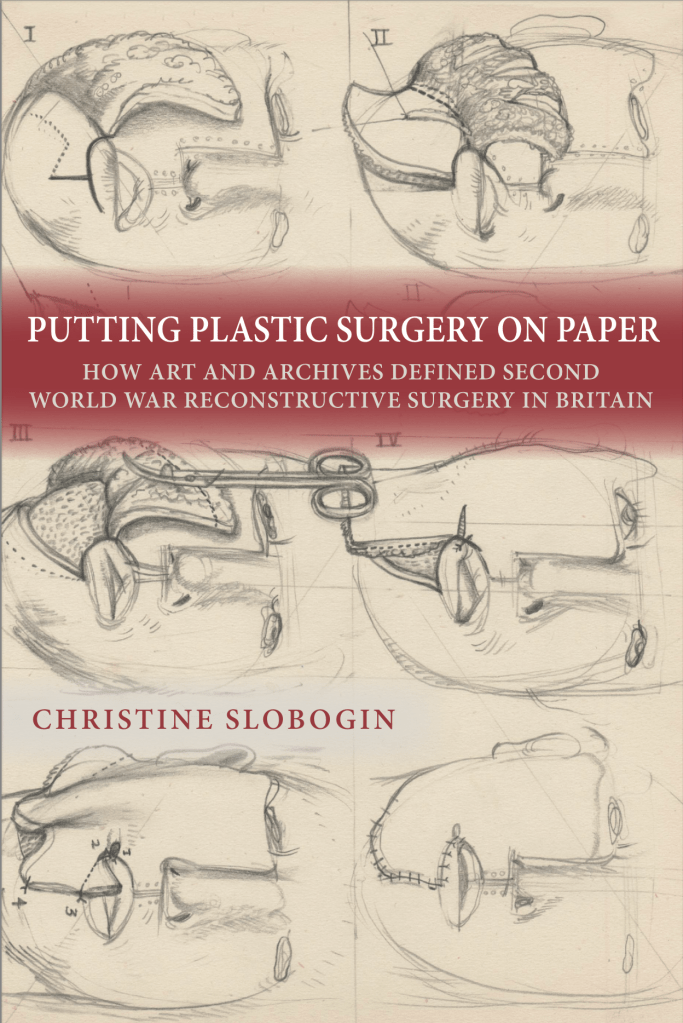
“Putting Plastic Surgery on Paper reminds us that the history of medicine needs art history. Beginning with the premise that visual culture lies at the center of plastic surgery and its archives, the book demonstrates how much we have to gain by looking closely at medical illustrations, analyzing them in relation to both clinical and non-clinical images, and reading through a critical lens the biography of the surgeon as artist. This remarkably interdisciplinary book also models deeply ethical research as historians struggle to retrieve, and safeguard, patient experiences.”
– Tanya Sheehan, Colby College
An interdisciplinary approach to medical history that shows the key role that drawings and photographs had in shaping the material, professional, emotional and aesthetic parameters of plastic surgery.
Plastic surgery in twentieth-century Britain was a medical discipline with deep ties to art, artists and art history. It was also a field still in the process of creating its reputation and its archives. Putting Plastic Surgery on Paper examines these archives, focusing in particular on the works on paper held within these collections by two artists: Diana “Dickie” Orpen and Percy Hennell. Plastic surgeons depended upon the drawings and photographs made by these and other medical illustrators to craft certain narratives about their field and their surgical practice.
In addition to telling an art history of plastic surgery during this period, Putting Plastic Surgery on Paper engages with the affective parameters of archival objects, and with what working as a historian involves when done within potentially traumatic spaces. Paying particular attention to the emotional dimensions and effects of this visual culture and the ways in which it is archived and framed by the discipline of plastic surgery – then and now – Putting Plastic Surgery on Paper explores not only what it meant to make art in a surgical space, but also what it means to study these affecting paper objects in the archive today.
This book is available as Open Access under the Creative Commons license CC BY-NC-ND.
Review of Hannah Halliwell, Art, Medicine, and Femininity: Visualising the Morphine Addict in Paris, 1870-1914, H-Net-Sci-Med-Tech (August 2024)
Access the review here.
“Hidden in Plain Sight: The Covering of Patients’ Eyes and a Microethics of Medical Photography,” Medical Humanities (August 2024): 1-9.
Link to article here.
This article uses the author’s experience of researching historical photographs of facial injury and surgical reconstruction to think through the ethics of writing about and publishing images of patients anonymised by excising or covering their eyes. This article specifically highlights tensions between the British Medical Journal’s guidelines for patient anonymity in imagery and those of the archives of the British Association of Plastic, Reconstructive and Aesthetic Surgeons. The rules for reproducing these sensitive images are not standardised across disciplines nor across journals and medical archives. But by using lived academic experience, visual analysis and philosophical enquiry, a flexible personal directive (or microethics) for working with these images can be reached.
In order to more fully understand where the present-day suggestion of and debates around blocking out patients’ eyes for anonymity come from, this ethical analysis is tied back to the historical precedent of Harold Gillies’ 1920 publication Plastic Surgery of the Face, in which civilians’ eyes are covered. Theories of looking and of photography unpick some of the complex ideas that these images raise regarding patient agency in medical imagery. This article will have direct application for any researcher grappling with similarly difficult material wondering how to frame their own microethics or ethics in practice for discussing, showing or publishing these types of images.
Review of Marsha Morton and Ann-Marie Akehurst, eds., Visual Culture and Pandemic Disease since 1750: Capturing Contagion, The British Journal for the History of Science (April 2024)
Access the review here.
Review of Christos Lynteris, Visual Plague: The Emergence of Epidemic Photography, Bulletin of the History of Medicine (December 2023)
Access the review here.
“‘’E’s a funny doctor’: Dickie Orpen and the Visual Humour of the Second World War Reconstructive Surgery Ward,” in British Humour and the Second World War: “Keep Smiling Through” (Bloomsbury, June 2023).
More information on the edited volume here.
Facially wounded patient’s need for conviviality and good humor during the Second World War has been well established by medical and social historians. This chapter examines cartoons by surgical artist Dickie Orpen, who worked in a plastic reconstructive ward during the war, to show that those who worked at these wards also found ways to lighten their experiences of facial injury and reconstruction.
Review of Jason Bate, Photography in the Great War: The Ethics of Emerging Medical Collections from the Great War, History of Photography (April 2023).
Access the review here.
“‘Something useful in a National sense’: Percy Hennell’s Surgical and Nationalist Colour Photography, 1940-1948,” Visual Culture in Britain (November 2022).
Link to article here.
Photographer Percy Hennell (1911–1987) is best known for his colour images of Second World War reconstructive surgery, but he also illustrated the books British Women Go to War (1943) by J. B. Priestley and An English Farmhouse and Its Neighbourhood (1948) by Geoffrey Grigson and John Piper. Seemingly disparate, these three groups of 1940s photographs are united by the devices – specifically British colour, the before-and-after trope and detailed documentation – that showcase British nationalisms and anxieties. Hennell’s more commercial projects help to provide a better understanding of the role of propaganda and nationalism in Second World War surgical imagery.
“Your face tomorrow: war and reconstructive surgery,” Times Literary Supplement (June 2022).
Link to article here.
This article for the Times Literary Supplement reviews Lindsey Fitzharris’s popular history book on plastic surgeon Harold Gillies, titled The Facemaker: One Surgeon’s Battle to Mend the Disfigured Soldiers of World War I. I argue, among other things, that this book emphasizes the team-led aspect of reconstructive surgery, unlike what is suggested by the title.
“Collecting Affect: Emotion and Empathy in World War II Photographs and Drawings of Plastic Surgery,” Medical Humanities (August 2021).
Link to article here.
This article compares drawings by Diana ‘Dickie’ Orpen (1914–2008) with photographs by Percy Hennell (1911–1987); both of their oeuvres depict plastic reconstructive surgeries from World War II in Britain. Through visual analysis, personal experience and interviews with archivists who have worked with the collections, this article aims to determine the affective effects of these drawings and photographs. I argue that Hennell’s images are the more affective and subjective objects, even though their original purpose was objective and scientific. This article asks why Hennell’s photographs of plastic surgery produce such a vehement emotive response.
Investigating Hennell’s use of colour, his compositional choices and the unexpected visual particulars of the operating theatre that he captures—all of which ‘collect affect’ within the photo-archival object—this analysis uses a phenomenological framework to determine the limitations and strengths of two very different styles and mediums of World War II surgical imagery.
Beyond establishing which group of images is more affecting, this article also shows why it is empathy that is the most fitting emotional description of the typical responses to Hennell’s photographs. This type of visual analysis of empathic images can be applied to objects-based medical humanities pedagogy that encourages empathy—historical empathy as well as empathy in the present day—for surgical practitioners and trainees.
“Breathless Rictus: Ken Currie’s Krankenhaus,” Dandelion (Autumn 2018).
Link to article here.
This article reviews Ken Currie’s show Rictus, which ran at the Flowers Gallery on Cork Street in London from 8 November – 9 December 2017. While Currie had many paintings in the show, Krankenhaus is the eerie, unsettling, and powerful zenith of Currie’s work. It contains many of the themes on which Currie continuously ruminates (like the distrust of doctors or the fragility of the human body) but Krankenhaus also curiously focuses on the rhythms and weaknesses of breath and breathing. The painting visually touches on themes of suffocation, rupture, violence and death while also inspiring breathlessness and unease in viewers. This review focuses on Krankenhaus as the linchpin of Currie’s show and an explanation of his thoughts regarding medicine, humanity, and art.
 Dr. Christine Slobogin